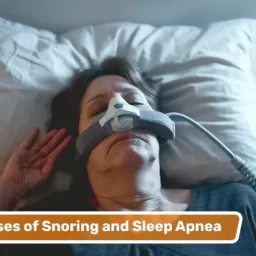


Loud snoring, difficulty breathing at night, feeling sleepy even after getting a full eight hours’ sleep at night – all of these symptoms are usually dismissed as normal problems. However, these can be signs of a much more serious problem called Obstructive Sleep Apnea (OSA). It is when breathing is interrupted in a recurring manner during sleep. This is not only a major problem for your sleeping pattern, but is also a significant health risk factor.
At Aashwi ENT Hospital, Ahmedabad, specialists like Dr Mihir Mehta and Dr Manish Goyal see this pattern often. Because sleep apnea usually starts with a physical obstruction somewhere in the nose, throat, or airway, ENTs are often the right first stop for anyone who suspects something’s wrong with the way they breathe at night. Here’s a closer look at how a sleep apnea diagnosis ENT evaluation actually plays out, answered through the questions patients ask most.
Sleep Apnea Diagnosis ENT
Can an ENT Doctor Diagnose Sleep Apnea?
To a large extent, yes. Dr Mihir Mehta and Dr Manish Goyal often point out that sleep apnea is, at its root, an anatomical problem — the airway collapses or narrows during sleep, and where exactly that happens matters a lot for treatment. That’s the piece an ENT is trained to find. A sleep study is still needed to confirm the diagnosis formally, but the clinical exam tells the doctor where to look and why it’s happening in the first place.
![Sleep Apnea Diagnosis ENT]()
 What Questions Will an ENT Ask During a Sleep Apnea Evaluation?
The first appointment is mostly a conversation. Expect to be asked things like:
- How loud or frequent is your snoring, and has anyone else noticed it?
- Have you ever gasped or choked awake, or had someone tell you that you stopped breathing for a moment?
- Do you feel unusually sleepy during the day, even after what should be a full night’s rest?
- Do you wake up with a headache or a dry mouth most mornings?
- Have you noticed trouble concentrating or mood swings that feel out of character?
- Is there a history of high blood pressure, obesity, or sleep apnea in your family?
Interestingly, doctors at Aashwi ENT Hospital often say the most useful answers come not from the patient but from whoever shares their bed — since most people have no idea their breathing is interrupted while they’re asleep.
What Happens During the Physical Examination?
Next comes a hands-on look at the airway. Dr Manish Goyal typically checks for:
- Nasal blockages — a deviated septum, polyps, or ongoing congestion
- Enlarged tonsils or adenoids, which are especially common culprits in children
- Soft palate and throat structure — an unusually long soft palate or a large uvula
- Jaw and neck shape — a recessed jaw or a thicker neck circumference can narrow the airway
- Tongue position — a tongue base that falls backward can block airflow during sleep
More often than not, this exam alone gives a strong clue about what’s going on, even before any formal test is ordered.
Do You Actually Need a Sleep Study?
Yes, in almost every case. An ENT exam can raise strong suspicion of sleep apnea, but polysomnography — commonly called a sleep study — remains the only way to confirm it. It’s the kind of test that turns “this looks like sleep apnea” into an actual number your doctor can work with.
What Does a Sleep Study Measure?
Overnight, sensors quietly track:
- Breathing patterns and airflow
- Blood oxygen levels
- Heart rate and rhythm
- Brain activity, to map out sleep stages
- Eye movement and muscle activity
- How much (and how loudly) you snore
Is the Sleep Study Done at Home or in the Hospital?
Both are possible, and Dr Mihir Mehta usually helps patients decide based on how severe their symptoms seem:
- In-lab sleep study — an overnight stay at the hospital under supervision, giving the most detailed picture
- Home sleep apnea test — a simpler, portable setup that works well for milder or lower-risk cases
Neither option is one-size-fits-all, which is why this decision is made case by case.
How Is Severity Measured?
The sleep study produces something called the Apnea-Hypopnea Index (AHI) — basically, how many times your breathing is interrupted per hour of sleep. Roughly speaking:
- Mild — 5 to 15 interruptions an hour
- Moderate — 15 to 30 interruptions an hour
- Severe — more than 30 interruptions an hour
This number shapes everything that comes next in treatment.
Are There Other Tests an ENT Might Order?
In more difficult cases, Dr. Manish Goyal may suggest a couple more procedures for determining the location of the blockage:
- Nasal endoscopy – A slender, flexible instrument is inserted into the nasal cavity and pharynx to get a good look at the inside
- Drug-Induced Sleep Endoscopy (DISE) – Monitors the way the airway collapses while the patient is under sedation; usually done before considering surgery.
- Imaging (X-ray/CT) – useful for determining bone and soft tissue structures in more complicated cases.
What Happens After Diagnosis?
Once the diagnosis and severity are clear, treatment gets built around the specific cause — not a generic template. Depending on what’s found, that could mean:
- Nasal surgery, if a structural blockage is the main issue
- Removing enlarged tonsils or adenoids
- CPAP therapy for moderate to severe cases
- An oral appliance for milder cases, or for patients who can’t tolerate CPAP
- Practical lifestyle changes — weight management, adjusting sleep position, and so on
This is really the value an ENT brings to sleep apnea care: the treatment goes after the actual physical reason behind the problem, not just the symptoms sitting on top of it.
When Should You Actually See an ENT?
It’s worth booking a sleep apnea diagnosis ENT evaluation if any of this sounds familiar:
- Loud snoring that’s become a nightly thing
- Someone’s told you that you stop breathing, or gasp, while asleep
- You’re tired all day, no matter how much you sleep
- Morning headaches or a consistently dry, sore throat
- Trouble focusing, or irritability that seems to come out of nowhere
Dr Mihir Mehta and Dr Manish Goyal at Aashwi ENT Hospital, Ahmedabad, see patients for exactly this kind of evaluation — and catching it early makes a real difference, both for sleep quality and for the heart and metabolic issues that tend to follow untreated sleep apnea.
For more information, click below:
Aashwi ENT Clinic | ENT Specialist in Gandhinagar, Gujarat
Aashwi ENT Clinic Bopal | ENT Doctor, ENT Hospital, ENT Specialist, Ear, Nose, Throat Doctor