

Are you suffering from nasal congestion, facial pressure, or sinus infections that have been going on for a long time and have not responded to medication? In such cases, if you are in Gujarat or the nearby areas, then Endoscopic Sinus Surgery in Ahmedabad is the way out for you. It is an advanced, minimally invasive procedure that can breathe you back to life, permanently.
The Aashwi ENT Hospital’s Dr Mihir Mehta and Dr Manish Goyal are top ENT specialists who are extremely reputed for their expertise in FESS surgery. They form part of a community of excellent ENT doctors who are the first point of call when it comes to endoscopic sinus surgery in the medical scene of Ahmedabad.
This write-up is meant to be a guide that we present to you about the working of endoscopic sinus surgery, the reasons that make Ahmedabad a possible hot spot for the surgery, the recovery, and the ways of selecting the right surgeon.
Endoscopic Sinus Surgery in Ahmedabad: What You Need to Know
Chronic sinusitis, nasal polyps, or severe nasal blockage have the potential to deteriorate one’s quality of life severely. When conservative treatments (antibiotics, sprays, decongestants) fail, a surgical procedure often becomes the only choice. Endoscopic sinus surgery (also known as Functional Endoscopic Sinus Surgery, FESS) is a forefront technique among the surgical methods.
Many ENT surgeons have achieved the dissemination of minimally invasive surgery by the wide-scale application of this technique in Ahmedabad.
![Endoscopic Sinus Surgery in Ahmedabad]()
 Who Are the Leading ENT Surgeons for FESS in Ahmedabad?
If you decide to go for Endoscopic Sinus Surgery in Ahmedabad, then the first thing that you have to consider is the surgeon’s reputation and experience. There are two main specialists to say the least:
- Dr. Mihir Mehta, the ENT/otorhinolaryngologist of the highest standard, located in Ahmedabad, Dr. Mehta, is practicing at Aashwi ENT Hospital and is known for his dexterity in nasal and sinus surgery.
- Besides that, Dr. Manish Goyal is an expert in surgeries related to the sinuses, sleep apnea, and the tracheal area. He is also a member of the Aashwi ENT Hospital.
The Aashwi ENT Hospital, with its state-of-the-art infrastructure and surgical support, is a pillar of Ahmedabad for ENT/sinus work.
Both of these surgeons have the necessary qualifications and are well known in the area; when looking for other surgeons, check to see if they have the same level of experience in FESS/sinus surgery.
What Does Endoscopic / Minimally Invasive Sinus Surgery (FESS) Involve?
- Explanation & Aim
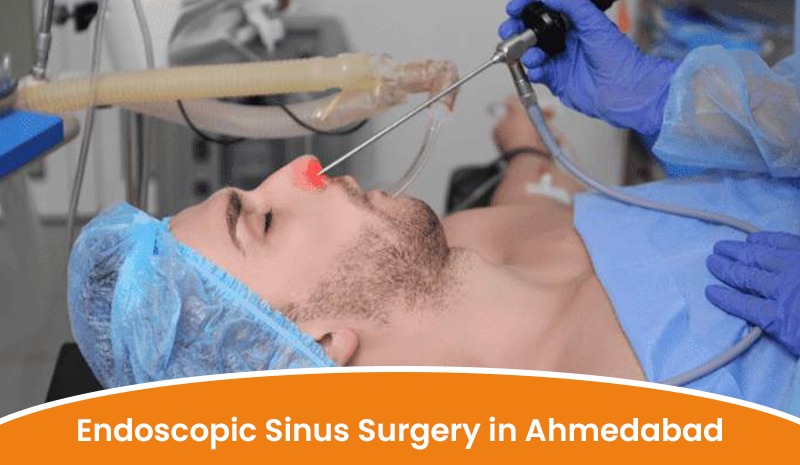
Endoscopic sinus surgery is the application of minimally invasive, fiber-optic endoscopes through the nasal passages (without external incisions) for the removal of infected tissue, the opening of blocked sinus passages, and the restoration of normal sinus drainage.
- Why “minimally invasive”?
This is because there is no external skin cutting; everything is done inside the nose via tunnels. It cuts down on the incision area, damage, and the healing period.
- How it differs from a typical open operation
In traditional methods, there is the possibility of external incisions or bone removal. However, endoscopic procedures keep more of the patient’s anatomy intact; thus, the recovery is faster and the visualization is improved.
- When is it used?
Examples of such indications are: medically intractable chronic sinusitis, nasal polyps, fungal sinus disease, recurrent sinus infections, and structural blockages.
- Operation stages (simplified)
- The doctor puts the endoscope through the nostril while the patient is under general anesthesia.
- With the help of micro-instruments, the doctor takes away the obstructive tissue (polyps, mucosa), pulls open the sinus openings, and unblocks them.
- Image assistance (navigation) might also be there for accuracy.
- Small bleeding and gentle handling are part of important parts.
- The time for the whole operation may be 1–2 hours or more, depending on its extent.
What Is the Cost of Endoscopic Sinus Surgery in Ahmedabad?
The price of Endoscopic Sinus Surgery in Ahmedabad depends on many factors, including:
- The surgeon’s deal and the level of experience
- Hospital (tertiary, private, accommodations)
- Implementation of image-guided navigation systems
- Length of hospital stay (day care vs overnight)
- Difficulty (extent of disease, presence of polyps, revision surgery)
- Preparatory examinations and recovery after the surgery
It is quite difficult to find the exact publicly published rates, but a rough estimate could vary from ₹80,000 to ₹2,50,000+, depending on the hospital and complexity. (It would be better if you directly contact the hospital/surgeon for a quote that is tailored just for you.)
When you compare the rates, make sure that the accounts include diagnostics, medications, follow-ups, and any revision costs.
Recovery Timeline & What to Expect Post Surgery
One of the main benefits of using the endoscopic/minimally invasive technique is the patient’s recovery. Here is a common timeline:
- Day 0-1: After the operation, patients are on the watch. There may be nasal packing or soft splints in place.
- Day 2-3: Removal of packing (if utilized). Slight discomfort, nasal congestion, and some watery or slightly bloody discharge are the patients’ symptoms.
- Week 1: Usually, the nasal irrigation (saline sprays or rinses) starts. Heavy exertion, blowing the nose, and bending over are prohibited.
- Week 2-3: The reduction in swelling and crusting. Restricted patients may perform light daily activities.
- Weeks 4-6: The major part of healing has been accomplished. Most of the discomfort subsides; follow-up visits for endoscopic de-crusting and evaluation take place.
- 2-3 months: Normal drainage is reestablished, and sinus mucosa regains function.
- 3-6 months: The majority of patients witness the complete improvement (fewer sinus infections, better breathing).
The proper implementation of postoperative care (saline irrigation, abstaining from irritants, and follow-up visits).
Risks, Complications & Success Rate of Endoscopic Sinus Surgery
Though safe overall, the procedures are not without potential risks.
- Bleeding
- Infection
- Formation of adhesions/scar tissue
- Polyp/disease recurrence
- Damage to structures that are close by (orbit, eye, skull base, cerebrospinal fluid leak)
- Alterations in smell (anosmia or hyposmia)
The chance of such adverse events is small if the operation is done by a qualified surgeon. High success rates (meaning considerable symptom relief) are estimated—most of the time, more than 80-90% in suitable conditions.
How exactly success depends on the severity of the disease, patient compliance, and the extent.
- Take medications (antibiotics, steroids, analgesics) exactly as prescribed
- If you experience unusual bleeding, fever, or vision disturbance, inform your doctor immediately.
- Sticking to the plan is strongly linked with positive results and a lower chance of relapse.
How to Choose the Right Hospital and Surgeon in Ahmedabad
Here are some easy-to-follow tips:
- Start by checking the credentials & experience: The number of surgeries, focus on FESS/sinus surgery.
- Get info about the number of cases/outcomes: Revision operations, the occurrence of complications.
- Quality of infrastructure counts: Diagnostic tools (CT, MRI), navigation systems, endoscopy suite, ICU support.
- Postoperative care & follow-ups: Is there a proper routine for irrigation, de-crusting, and control?
- Patient reviews / referrals: Opinions of patients, spoken recommendations.
- Accessibility & logistics: Hospital’s location, accommodation, and helpers.
In Ahmedabad, Aashwi ENT Hospital is well-established and is under the management of both Dr. Mihir Mehta and Dr. Manish Goyal. It is an advantage for patients as they get the integrated experience of surgeon + hospital.
Do not forget to consult and ask the above questions before making the final decision.
Preoperative Preparation & Postoperative Care Guidelines
Before surgery (preop):
- A complete physical check-up, including blood tests, ECG, and imaging (CT scan)
- Stop taking specific drugs (e.g., blood-thinners) that the doctor will instruct you to stop
- Do not use nasal sprays for a short time before surgery (according to the instructions)
- Go over anesthesia, risks, and expectations
- Set up transportation for after surgery and arrange for a helper at home
After surgery (postop):
- Use saline spray or lavage as directed
- Do not blow your nose, bend, or do heavy lifting for a few weeks
- Sleep with your head raised
- Go to the scheduled de-crusting / nasal endoscopy appointments
- Stay away from irritants (smoking, dust, allergy-causing substances)
- Take medications (antibiotics, steroids, analgesics) exactly as prescribed
- If you experience unusual bleeding, fever, or vision disturbance, inform your doctor immediately.
Sticking to the plan is strongly linked with positive results and a lower chance of relapse.